By Dr. Ben Bloom, Atom Computing's CEO and Founder
A few weeks ago, I spoke at Quantum World Congress (QWC) at the University of Maryland to provide media, analysts, customers, and industry peers with an update on Atom’s technical progress and roadmap. As part of that keynote, I discussed the three big challenges that quantum companies across the industry are facing to build viable, utility-scale systems: scale, speed, and fault-tolerance. Solving these three challenges unlocks a path to computing power that enables transformative calculations in drug discovery, molecular simulation, and cryptography that are impossible for classical supercomputers to solve today.
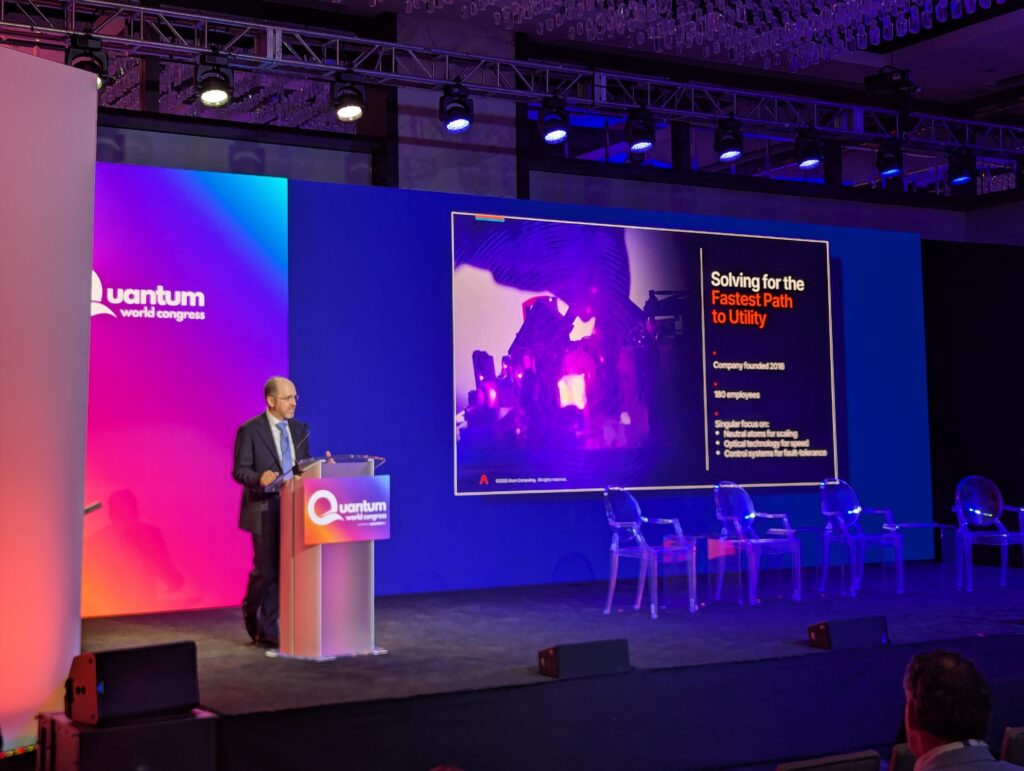
Followers of Atom Computing (and the neutral-atom modality in general) know that we demonstrated our technology’s ability for aggressive scaling with our 100-qubit prototype system and our 1,200+ qubit AC1000 systems. At QWC I shared our product roadmap, which shows that we are continuing to target a 10x increase in physical qubits per generation, and that Atom is on track to deliver the world’s first fault-tolerant quantum supercomputer by 2029 with over 1,000 logical qubits.
Fault tolerance is also essential for quantum supercomputers to achieve utility scale and power a generational technology shift. Having published demonstrated milestones and progress on logical qubits since 2024, Atom is the first neutral atom company to demonstrate and publish full, end-to-end, quantum error correction for many continuous rounds, making it one of only two companies in the quantum industry to achieve this feat.
Speed matters
What remains is the third big quantum challenge, which is speed. In our industry, the neutral-atom modality has the reputation of being “slow” compared to, for instance, superconducting technologies because gate speeds are typically measured in microseconds instead of nanoseconds. It’s understandable why industry experts focus on that. But users care more about the overall time-to-solution and whether quantum computers could reliably compute problems in a reasonable amount of time. We believe that focusing on individual system performance specs as an indicator for overall system performance does not show the full picture. For fault-tolerant systems to operate at utility scale, we must consider all factors that contribute to system computation time, such as qubit connectivity, logical qubit overhead, and execution speed.
In my keynote address at QWC, I revealed that we have solved the speed gap compared to other modalities by addressing bottlenecks and delivering time-to-solution for neutral atom systems on par with superconducting qubit-based quantum computers.
We are addressing speed on multiple fronts, starting with gate speeds. Typical neutral atom gates require microseconds to manipulate the qubit’s quantum state. We are implementing new gate technologies that manipulate the qubit’s quantum state more efficiently than before and reduce that time to nanoseconds. The added benefit is that a faster gate speed also allows the gate to "outrun" low-frequency noise and perform better.
We’re also focused on readout speed. Atom’s qubits are read out through laser light illumination to capture the emitted photons. Through new optical technology, we can significantly enhance the rate at which photons are captured on cameras, reducing readout times by orders of magnitude.
Another key factor is the control systems, which are developed in-house to optimize the orchestration of quantum error correction protocols on our computers. We are also exploring NVIDIA’s NVQLink along with GPUs and other hardware improvements to reduce latencies and increase overall operating speed.
The last focus area for us is arbitrary movement. We have developed optical display technology to simultaneously move many qubits to arbitrary locations. This parallelization enables all-to-all qubit connectivity, many simultaneously executed independent two-qubit gates, and efficient complex logical qubit manipulations. This provides massive acceleration of overall algorithm execution, similar to the way that GPUs act as accelerators over CPUs. It also creates a flexible platform for continuously improving quantum error correction algorithms, meaning that a single platform does not need to be locked into a single type of logical qubit performance.
The quantum market has officially reached a turning point where neutral atoms have surged to the front of the fault-tolerant race. By closing the speed gap, Atom Computing is in an excellent position to be the first company to build utility-scale quantum computers that deliver real value for its users.