By Dr. Jonathan King, Atom Computing's Co-Founder and Chief Scientist
Today our team announced a big milestone for Atom Computing and for the broader quantum computing industry: we present the first complete demonstration of quantum error correction with neutral atom qubits (click here to read the scientific paper), making us only one of two companies that have demonstrated many rounds of performant error correction, and the first neutral-atom company to do this (the other company, Google, used superconducting qubits).
I’m incredibly proud of the Atom Computing team, the hard work and the commitment that went into this. And I’m also very excited for what the future holds for us and our technology.
A Dark Horse No More
Long considered a dark horse, neutral atom qubits have recently received much attention as a platform for quantum computing. This is a result of both recent experimental demonstrations taking advantage of the inherent scalability and flexibility of neutral atoms (by for instance leveraging all-to-all connectivity between the qubits) and a growing number of proposals for utility-scale neutral-atom architectures with impressive efficiency and performance.
Directly related to this momentum (if not driven by it) is the industry’s focal shift from physical qubits to error-corrected logical qubits. Increasing numbers of people and organizations are recognizing the potential that neutral-atom quantum computers have in terms of exploring more efficient quantum error correction codes and the logical qubits that go along with that. I’m proud that Atom Computing is the first company to have sold a logical-qubit quantum computer, leading a shift in the quantum computing market.
Correcting for Lost Qubits
Neutral-atom and trapped-ion quantum computing platforms have a unique challenge: occasionally, as a by-product of operations on the qubits or a collision with a stray gas molecule in the vacuum chamber where the qubits are held, a qubit permanently disappears and its information is lost. This deletion of information (called an “erasure error”) can fortunately be handled very efficiently by quantum error correction, and when executed fast enough the lost qubits can be replaced with fresh qubits and the computation can continue with minimal disruption.
But here is the catch: the processes of detecting and replacing lost atoms can create errors themselves, so any complete demonstration of quantum error correction must:
In order to build a useful, utility-scale quantum computer using neutral atoms, you have to integrate all of these steps to enable continuous operation of an error corrected logical quantum memory. In previous publications (here, here, and here), we demonstrated solutions to the first three requirements, and today’s announcement demonstrates the final fourth step.
A Complete Demonstration of Quantum Error Correction
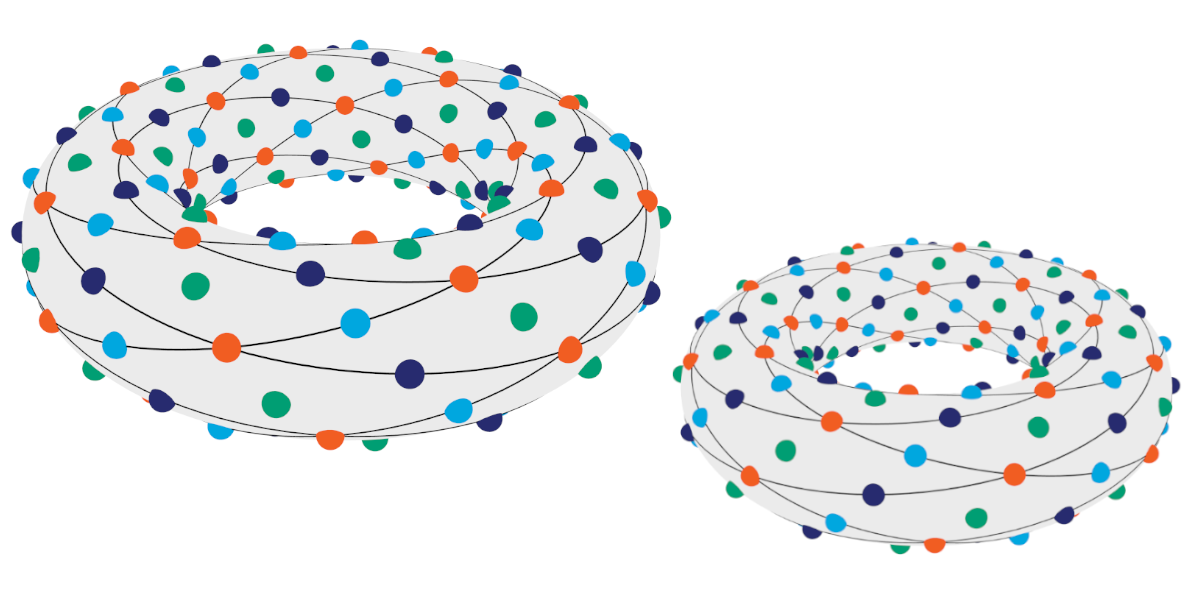
In today’s published work, we demonstrated an error-corrected quantum memory using a version of the toric code, one of the earliest proposed quantum error correction codes. The toric code requires non-local connections between qubits and cannot be implemented in a 2D planar geometry, thus demonstrating a key advantage of the flexibility when using neutral atoms with all-to-all connectivity over, for instance, superconducting qubits that have a fixed topology.
The key component of our demonstration is a quantum memory encoded in the toric code. The quantum memory involves periodically reading out information about errors in the error-corrected logical qubit while preserving its quantum information. The key metric of performance is the logical error rate after many cycles of error correction. We demonstrated up to 90 rounds of error correction, identifying and replacing lost qubits at each step (see Figure 1).
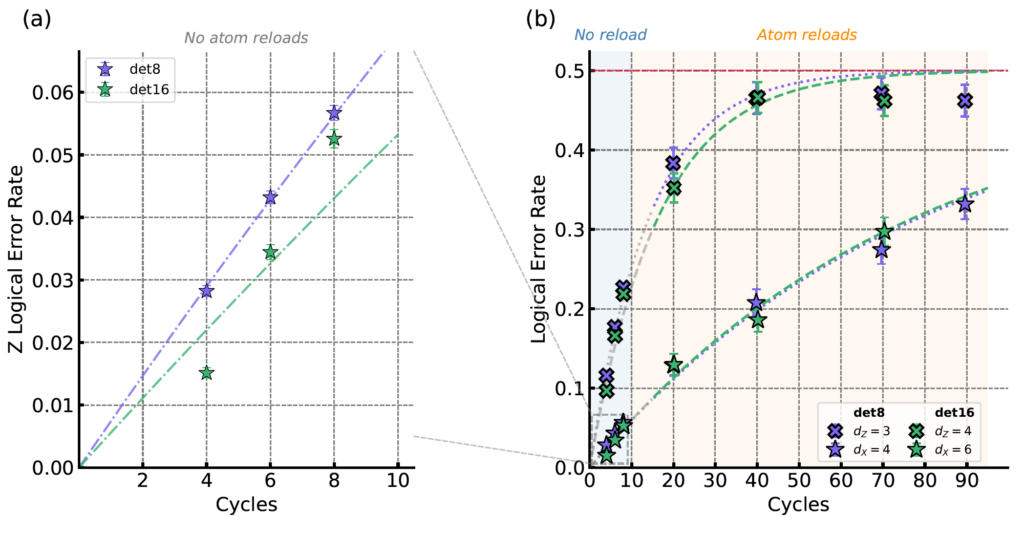
Figure 1: Logical error rate vs. cycles of error correction in our quantum memory experiment. For lower numbers of cycles (Fig. 1.a.), the higher distance code (green) exhibits lower error rates than the lower-distance code (purple). For higher numbers of cycles (Fig. 1. b.), including continuous atom reloading, the error rates are similar, suggesting near-threshold performance.
I want to point out why this is different from other apparently similar demonstrations by other neutral atom and ion quantum computing companies. First, we measure logical error rates including mid-circuit measurement, which must operate without damaging the information in non-measured qubits. Second, the system needs to be able to continuously reload qubits while performing all these operations, otherwise its runtime would be limited as the computer runs out of qubits. We are the first neutral-atom company to check these two boxes while demonstrating the quantum memory, making it a “complete demonstration”.
The purpose of error correction is to achieve lower logical error rates by increasing the amount of redundancy in an error correction code, which we often refer to as the “code distance”. So, simply put, the logical error rate should go down as you increase the code distance of your error correction code (which typically means adding more physical qubits to encode a logical qubit).
We observed logical error rates went down when comparing distance-4 code to distance-6 code, consistent with the desired “sub-threshold” behavior when running the code. This was especially clear when we did less than 10 rounds of error correction. Beyond 10 rounds, reloading from the atom source is required to replenish qubits and we observed similar error rates between the code distances, suggesting operation near the error correction threshold.
Impact in the Industry
These results place Atom’s technology on the same footing as Google’s superconducting qubit systems as the only companies to achieve deep quantum memory demonstrations and are a major validation of neutral atoms as a platform for error-corrected quantum computing.
This underlines the momentum that neutral atoms have in the industry, and we believe this demonstration establishes our neutral atom technology is one of the frontrunners if not leading the race to useful utility-scale quantum computing. I’m expecting to see an accelerating shift of academic and industrial interest from other modalities to Atom’s neutral-atom quantum computers.
Outlook
Since the founding of Atom Computing, we have been focused on achieving useful, utility-scale quantum computing, investing in the science and engineering behind these capabilities.
The next steps on this journey include further improvement in physical performance to push well below the error correction threshold and increasingly high logical fidelity, scaling to more sophisticated error correction codes that take full advantage of neutral atom flexibility, and demonstrating real-world use-cases that leverage all of these advancements.
I’m excited to see what’s next!
Click here to read this Tech Perspective's accompanying press release.